
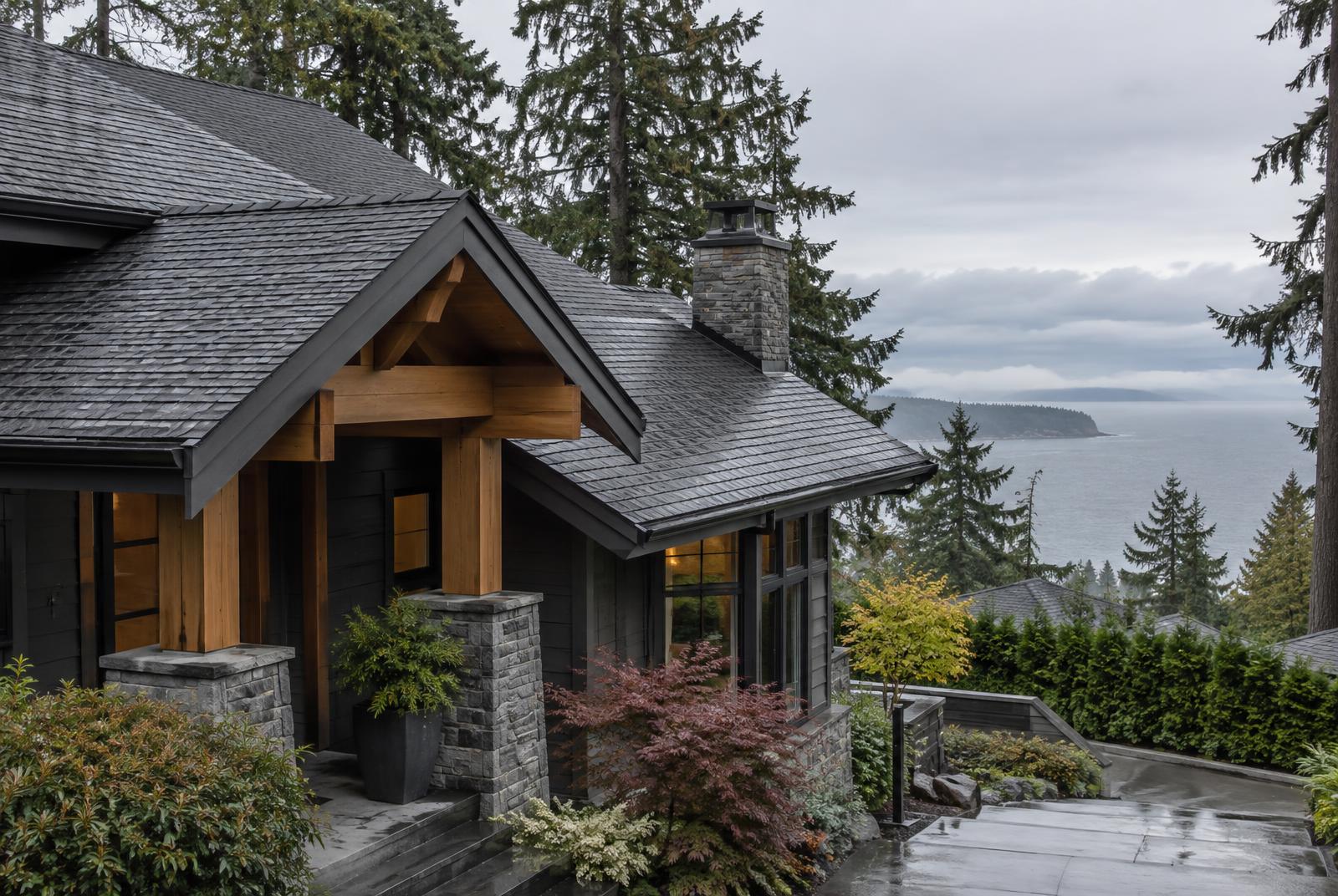
On most White Rock homes the roof is the single largest surface anyone sees from the street, and a change of colour or profile will do more for the exterior than new paint or landscaping. It is still the wrong place to start. Above the bluff you are dealing with salt air, wind that drives rain sideways up a slope, and fir and cedar debris landing on the roof most of the year. The material that looks best on a sample board is not always the one that performs on your particular roof.
Have the roof assessed before you decide to replace it
Moss, dark streaking and a tired appearance are not proof that a roof is finished. Streaks are often algae growth, and moss frequently sits on shingles that still seal and flex properly underneath. If the deck is sound, the flashings are intact and the shingles are not shedding granules into the gutters, appropriate cleaning and targeted repair work can be the sensible route for several more years.
That is the first thing we establish on site. A proper condition assessment looks at the roof deck, the flashing assemblies at walls and chimneys, and the attic ventilation from inside. If a repair will reliably extend the roof's service life, we put that recommendation in writing rather than quoting a replacement you do not need.
What White Rock actually does to a roof
Four local conditions carry more weight here than material preference:
- Marine air. Salt-laden moisture attacks exposed fasteners, vent collars and unprotected metal long before it affects the roof covering itself.
- Wind-driven rain. On the hillside and along Marine Drive, water does not simply run downslope. It is pushed up under shingle courses and into sidewall transitions, which is why flashing detail matters more than the shingle brand.
- Roof shape. Steep multi-gable and dormered roofs have far more valleys, hips and wall intersections than a simple gable, and every one of those is a place water has to be managed deliberately.
- Overhanging trees. Mature firs and cedars drop needles into valleys and gutters year-round, hold moisture against the surface and shade the roof so it never fully dries between systems.
Architectural asphalt shingles
For most single-family homes in White Rock, quality architectural shingles remain the practical choice. The laminated profile gives real depth and shadow lines rather than the flat look of older three-tab shingles, the colour range lets you coordinate with siding, stone and trim, and the installed cost is well below composite or metal.
The considerations are straightforward. Expect a shorter service life than the alternatives on a heavily shaded, tree-covered roof, and plan on periodic clearing so needles and moss are not left sitting on the surface. Where trees hang over the roof, we recommend a shingle line with algae resistance and appropriate ridge venting so the deck breathes.
Brava composite shake and slate
Composite is the option homeowners choose when they want the appearance of cedar shake or slate without the maintenance that comes with the real thing. It is moulded from genuine cedar and slate originals, so the texture and staggered butt lines read as authentic from the street, and the colour runs through the material rather than sitting on the surface.
It also suits this coastline well: it does not rot, split, curl or feed moss the way cedar does, salt air does not corrode it, and it is considerably lighter than slate. It costs more than asphalt up front, and the pay-off is measured over decades rather than years. Our Brava composite roofing pages cover the profiles and colours, and if your home currently has cedar, the guide to replacing a cedar shake roof with composite explains how that conversion is handled.
Metal roofing
Metal gives you clean, deliberate lines and works particularly well on West Coast contemporary homes and on steep slopes where the panels are clearly visible. Nothing takes wind-driven rain better, moss has very little to hold onto, and the surface sheds debris instead of collecting it.
What it demands is precision. Panel layout, fastener choice, sealed penetrations and expansion allowance have to be right, and on a complex roof with many hips and dormers the flashing work becomes a significant part of the job. In a marine environment the coating system and fastener specification matter as much as the panel itself. It is a strong choice on the right roof, and an expensive mistake when detailed carelessly.
The details that decide how long any of it lasts
Whichever covering you choose, the same items determine whether the roof performs for its full service life:
- Step and counter-flashing at every wall and chimney, properly layered rather than sealed with caulking.
- Valley construction sized for the water a steep coastal roof actually carries.
- Balanced intake and exhaust ventilation so the underside of the deck dries.
- Corrosion-appropriate fasteners and vent collars for a salt-air location.
- Gutters and downspouts that clear needles rather than holding them.
Questions worth asking before you sign anything
- Is the roof deck being inspected once the old covering is off, and how is replacement sheathing handled in the scope?
- Which flashings are being replaced, and which are being reused?
- What is the ventilation plan, and does it change with the new material?
- Is the quote a complete written scope with a fixed price, or an estimate open to mid-project additions?
- What maintenance does this material need on a shaded, tree-covered roof, and what is covered by the workmanship warranty?
If keeping on top of clearing and inspection is not realistic, our roof maintenance program puts it on a schedule.
Where to start
Have the existing roof assessed, get the shape and exposure of your own roof on paper, then compare materials against that rather than against a showroom sample. True North Strong Contracting installs asphalt, Brava composite and metal roofing systems for White Rock homeowners, and we will tell you plainly when repair is the better spend. Call (604) 375-8672 to arrange a no-obligation property assessment, or see our White Rock roof replacement page for how a project runs from assessment to final cleanup.