
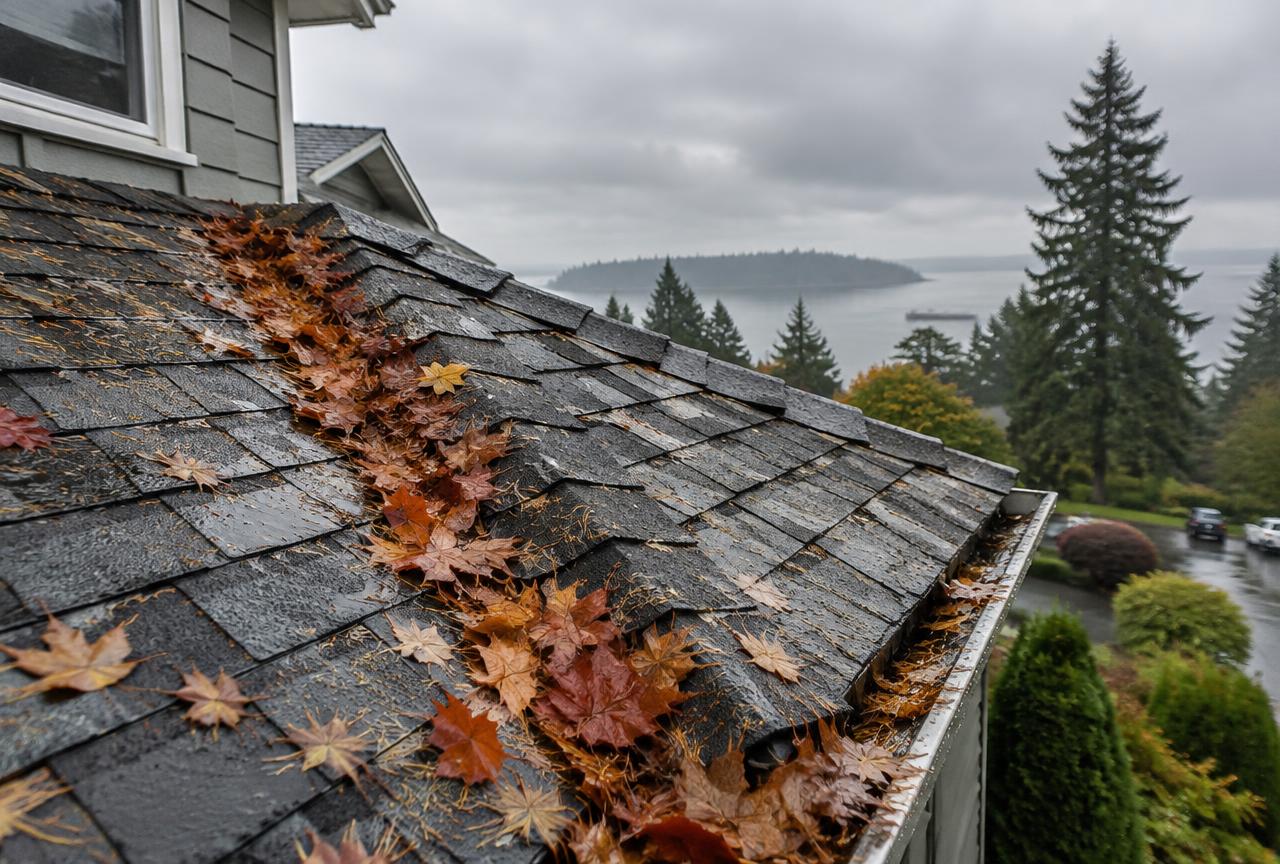
On the West Coast, roofs rarely fail in the middle of a storm because of the storm itself. They fail because something small went wrong months earlier and nobody had a reason to look. September and October are the few weeks when the weather is still workable and the problems from summer are still cheap to fix.
What summer quietly does to a coastal roof
A dry Lower Mainland summer is harder on a roof than most people expect. Weeks of direct sun and large day-to-night temperature swings dry out caulking and sealant beads, make metal flashings expand and contract at every joint, and turn the rubber boots around plumbing vents brittle enough to crack. None of that leaks while it is dry. It leaks the first time rain runs across it for three days straight.
That is why the first real autumn system so often produces a phone call about a ceiling stain on a roof that was perfectly fine all summer. The damage was already there; it just had no water to carry it inside.
Autumn debris is the other half of the problem
Maple and alder leaves drop over a few weeks, but fir and cedar needles come down all season and they are the ones that cause trouble. Needles pack into valleys and gutter troughs, hold water in place, and build a dam that pushes water sideways under the shingle courses instead of down the slope. Behind the fascia, that same backup soaks the board and the edge of the sheathing.
Blocked downspouts add to it from the bottom up. Once a trough is full, water sheets over the edge at the worst possible spots — over doorways, against siding, and into the soil next to the foundation. Clearing that in early fall takes an hour. Discovering it in January usually means repairing something.
A homeowner checklist for early fall
Do all of this from the ground or a stable ladder at the eave. Nobody needs to walk a wet roof.
- Look along each roof plane with binoculars for lifted, cracked or missing shingles left over from summer wind.
- Check the rubber boots around plumbing vents for splits or a ring pulling away from the pipe — one of the most common leak sources we find.
- Follow the metal where the roof meets a wall, chimney or skylight and look for rust, gaps or dried-out sealant.
- Clear leaves and needles from valleys, gutter troughs and downspout outlets, then run water and watch that it exits properly.
- Trim branches that overhang the roof, which reduces debris and lets the surface dry between systems.
- Check the attic after the first heavy rain: damp sheathing, dark staining around nails, or a musty smell all point to water getting in.
If you would rather work from a printed version, our roof condition checklist covers the same ground in a form you can carry outside.
Why the repair window matters so much here
Roofing work needs dry surfaces and reasonable temperatures. Sealants cure properly, new shingles seal down in the sun, and a crew can open up a section safely without racing a forecast. By late November on the coast, dry days come in short gaps, self-sealing strips on new shingles bond slowly in the cold, and anything opened up has to be tarped between shifts.
The practical result is that the same repair is quicker, cleaner and less disruptive in early fall than it is in the middle of winter — and far less expensive than the interior drywall, insulation and paint work that follows a leak nobody caught.
When fall repairs are the wrong answer
Sometimes the honest answer is that patching is no longer worth the money. If the roof is past twenty years, has been repaired in several different places, or is shedding granules into the gutters, targeted repairs buy a season rather than solve anything. Our guide to when a patch job isn't enough walks through where that line sits, and where leaks actually start explains what we check before recommending either one.
Already dealing with water coming in
An active leak is not a fall maintenance item. Move what you can out of the way, contain the water, photograph everything for your records, and call us — our steps for what to do when a roof is leaking cover the first hour safely.
Getting ahead of it instead
Most of the repairs we make in December were visible in September. If tracking it yourself is not realistic, our roof maintenance program puts the seasonal clearing and inspection on a schedule for homes and strata properties across Surrey, White Rock, Langley and the rest of the Lower Mainland. Either way, the work is worth doing before the rain settles in for the season.