
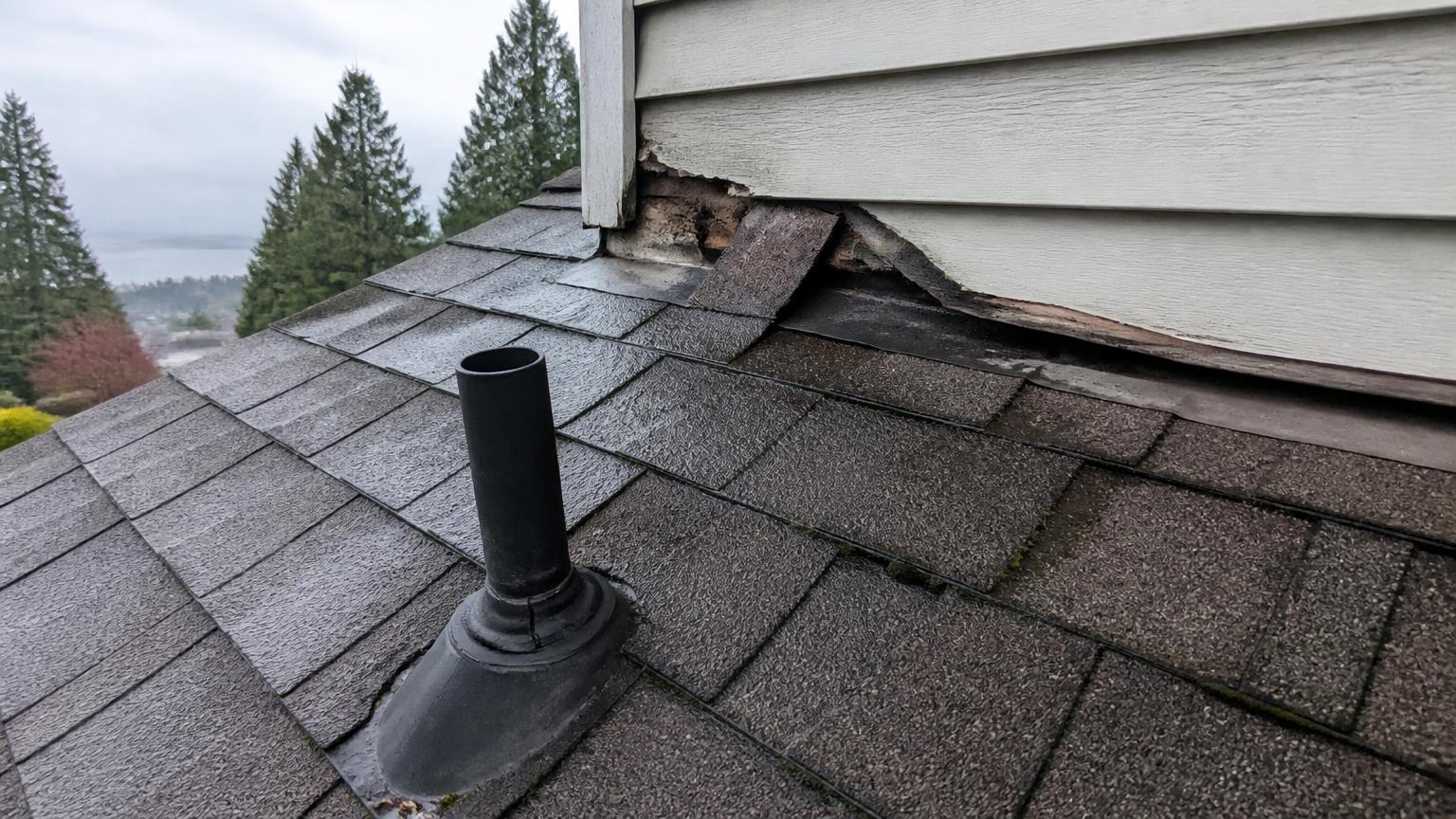
Almost no roof leak we get called out to in Surrey starts where the homeowner thinks it does. Water enters at a detail — a joint, a penetration, an edge — then travels along the sheathing or a rafter before it finally shows up on a ceiling several feet away. Knowing the usual entry points is what turns a mystery stain into a scheduled repair.
1. Flashing failures at walls, chimneys, and skylights
Flashing is the metal that bridges the roof to anything it runs into. It is the single most common leak source on Lower Mainland homes, especially step flashing where a roof plane meets a wall, and counterflashing at a chimney. Sealant used in place of proper flashing buys a few years, then cracks. If you see caulking as the main waterproofing at a transition, treat it as a known future leak.
2. Cracked vent pipe boots
Plumbing stacks pass through the roof inside a rubber collar. That rubber is usually the shortest-lived component up there — it hardens and splits from UV long before the shingles are finished. A split boot drips directly into the attic every time it rains, and the repair itself is small and inexpensive when caught early.
3. Blocked valleys and gutters
Under the fir and cedar canopy common in Surrey, White Rock, and Coquitlam, valleys collect needles that hold moisture against the roof surface and dam the flow during heavy rain. When a gutter is also full, water backs up under the shingle edge at the eaves. Most of this category is preventable with routine clearing rather than repair work — our coastal maintenance checklist covers the seasonal rhythm.
4. Storm-lifted or missing shingles
Wind lifts a tab, breaks the seal strip, and the shingle no longer sheds water the way it was designed to. The roof can look intact from the street and still be taking on water at one small spot. After a significant blow it is worth doing the post-windstorm walkaround from the ground.
5. Poor attic ventilation (the leak that isn't one)
A meaningful share of the "leaks" we inspect in the wet season are condensation. Warm moist indoor air reaches a cold attic, condenses on the underside of the sheathing, and drips. The tell is that it appears in cold snaps rather than during rain, and it shows up over bathrooms, kitchens, and laundry rooms. The fix is ventilation and sealing air leaks, not roofing.
6. Failed or aged underlayment on an old roof
Once the shingles are near the end of their service life, the leaks stop being one-off details and start being general. Multiple points of entry, granule loss across the field, and repairs that hold for one season are all signs you have moved from repair territory to replacement territory. Our guides on end-of-life signs and when patching stops making sense walk through that line.
What to do when you spot a stain
Contain the water, photograph everything with dates, and don't go up on a wet roof. If water is actively coming in, our leaking roof steps cover the first hour. Then book an assessment so the source is traced properly rather than sealed over — most of the causes above are straightforward repairs when they are found early.